By Tara Woodlee
Support, Healing, and Real-Life Coping Strategies for Every Stage of Motherhood
Mother’s Day after domestic violence doesn’t look the same for everyone.
For some, it’s a celebration.
For others, it’s complicated.
And for many survivors, it brings a mix of emotions that don’t fit neatly into a card, a caption, or a single moment.
This survivor-focused Mother’s Day guide isn’t about telling you how to feel.
It’s about creating space—and offering practical, supportive ways—to move through the day in whatever way feels safest, healthiest, and most manageable for you.
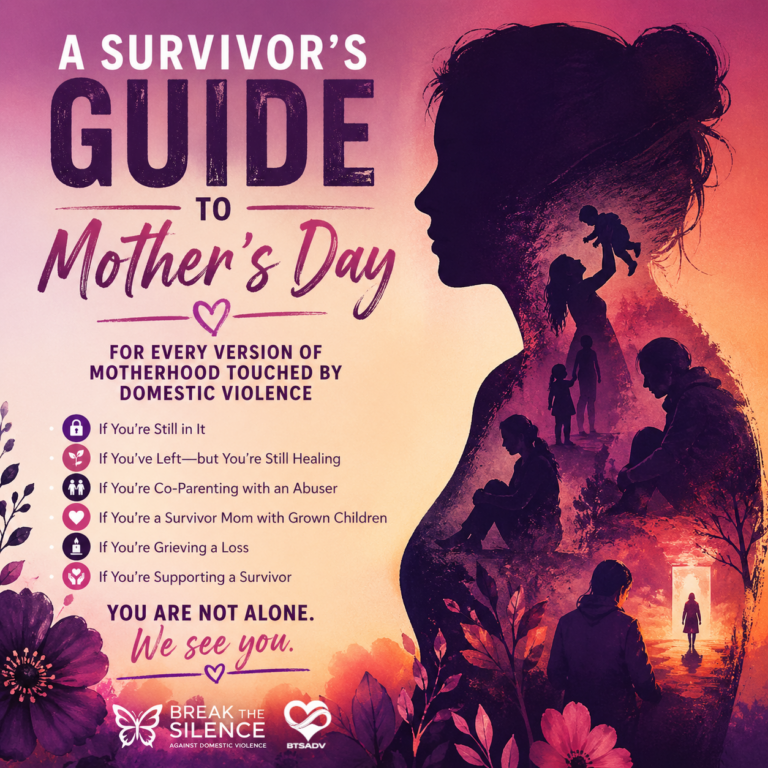
If You’re Still in an Abusive Relationship on Mother’s Day
Mother’s Day can bring added pressure when you’re still experiencing domestic violence—expectations, forced celebrations, or increased tension.
Here are ways to prioritize your safety:
- Keep expectations realistic. You don’t need a “perfect” day—focus on calm and predictability.
- Avoid known triggers. If certain situations lead to conflict, it’s okay to steer away.
- Have a quiet safety plan. Keep your phone accessible, know exits, and identify safe places.
- Take small moments for yourself. Even a few minutes alone can help regulate your nervous system.
Most importantly:
Getting through the day safely is enough.
If You’ve Left Domestic Violence but Are Still Healing
Mother’s Day after leaving an abusive relationship can feel confusing—relief mixed with grief, anger, or emotional exhaustion.
Helpful ways to cope:
- Release expectations. You don’t have to celebrate like everyone else.
- Create your own version of the day. Rest, go out, or ignore the holiday entirely.
- Expect emotional waves. Memories and feelings may surface unexpectedly—that’s normal.
- Limit contact if needed. Especially in co-parenting situations, keep communication minimal and focused.
You are not behind in healing.
You are exactly where you need to be.
Co-Parenting with an Abuser on Mother’s Day
Navigating Mother’s Day while co-parenting with an abusive ex can be especially challenging.
Consider these strategies:
- Maintain clear boundaries. Keep communication brief, factual, and child-focused.
- Plan ahead. Knowing schedules reduces stress and uncertainty.
- Prepare emotionally. You may not control the day—and that’s difficult, but valid.
- Celebrate on your own terms. If needed, create a separate, meaningful moment for yourself.
Your motherhood is not defined by control or access—it’s defined by your presence, love, and care.
For Survivor Moms with Adult Children
Mother’s Day with grown children can bring reflection, pride, and sometimes complicated emotions.
You might feel:
- Pride in who your children have become
- Questions about the past
- Distance or unresolved dynamics
Hold onto this:
- You parented through circumstances many will never understand.
- Your children’s adulthood is not a final judgment of your motherhood.
- Relationships evolve—and healing happens on different timelines.
- A text, call, or silence does not define your worth.
You are allowed to feel both pride and grief at the same time.
Grieving Loss Due to Domestic Violence on Mother’s Day
For those grieving the loss of a child or a mother due to domestic violence, Mother’s Day can feel especially heavy.
There is no right way to navigate it.
You might consider:
- Honoring your loved one privately. Light a candle, write a letter, or visit a meaningful place.
- Choosing connection—or solitude. Both are valid.
- Setting boundaries. Step away from anything that feels overwhelming.
- Letting the day be what it is. It may feel like survival, not celebration.
Grief doesn’t follow a calendar—and it doesn’t need to be hidden.
How to Support a Survivor on Mother’s Day
If someone you love is a survivor of domestic violence, this day may be harder than it appears.
You can support them by:
- Asking instead of assuming what they need
- Avoiding pressure to celebrate or “fix” the day
- Respecting boundaries without taking it personally
- Acknowledging their strength without minimizing their experience
Support doesn’t have to be loud to be meaningful.
Why Mother’s Day Can Be Difficult After Domestic Violence
Motherhood shaped by domestic violence is layered and complex. It can hold:
- Strength and fear
- Love and grief
- Survival and rebuilding
All at once.
You don’t have to force the day into something it isn’t.
Also you don’t have to meet expectations that don’t reflect your reality.
You only need to move through the day in the way that feels safest and most honest for you.
Domestic Violence Support Resources
If you need support this Mother’s Day, you are not alone:
- National Domestic Violence Hotline (24/7): https://www.thehotline.org/
- Break the Silence Against Domestic Violence (BTSADV): https://breakthesilenceagainstdv.org/
- 📞 BTSADV Support Line: 1-855-BTS-1777 (9 AM–9 PM CST, 7 days a week)
- 💜 Share Your Story: https://breakthesilencedv.org/?page_id=16824
Final Thoughts: You Define This Day
This Mother’s Day, your experience is valid—whatever it looks like.
You don’t have to celebrate, exsplain, or meet anyone else’s expectations
Just have to make it through in the way that feels right for you.
And that is more than enough.