By: Iris Davis Pendleton
Ptsd:the body remembers
I remember it like it was yesterday. He stormed into the house and declared loudly, “I’m tired of this %$#!” Then he rushed over, put his hands around my neck, and squeezed.
I closed my eyes and prepared for the end. I’m still not sure why he stopped that day, but he did. And when he released me, I felt something inside of me say:
Now you can leave.
Maybe I needed to hear those words because, for years, I had made so many excuses for why I couldn’t leave.
He was too sick. He was too indigent.
I had invested too much time.
What would people say? What would happen to him What would happen to us?
But in that moment, none of those excuses mattered anymore. I knew I had to leave.
When he stormed out of the house, I told my children to grab whatever they could carry. We rushed to the car, and I drove straight toward the interstate.
I didn’t know everything that would happen next, I only knew we were leaving.
That drive became the beginning of a new chapter of freedom in our lives.
That was six years ago.
But trauma doesn’t always understand calendars.
The attack happened from behind me. Even now, years later, I become uneasy when someone walks up or stands too closely behind me. It can happen in an innocent situation like standing in a grocery store line, walking through a crowded room, or talking with someone at work.
My body reacts before my mind has time to remind it that I am safe.
I back up, become defensive, and prepare myself to fight.
Just the other day, my husband, who is safe, was standing behind me while I was working at my desk. Before I could stop myself, I snapped at him because I could feel that familiar discomfort rising inside of me.
Another time, I almost hit a colleague who playfully snuck up behind me during a meeting.
They weren’t trying to hurt me.
I knew that, but for a moment, my body didn’t.
That is one of the difficult realities of trauma.
Sometimes you can know you are safe and still feel unsafe.
You can know the person standing behind you loves you and still feel your body tense. Hearing people arguing across a room can cause you to immediately brace yourself for an attack that is never coming.
Loud talking, yelling, sudden movements, and conflict can still make me jump.
Sometimes my heart begins racing before I even understand why.
My mind may recognize that the danger is over, but my nervous system remembers a time when loud voices, angry words, and someone coming up behind me could mean that I was about to be hurt.
There is a reason the book “The Body Keeps the Score” has resonated with so many survivors.
Trauma is not stored only in the stories we remember.
Sometimes it shows up in our shoulders tightening. Trauma shows up in the way we make decisions and react to certain situations. We may carefully scan a room before finding a seat. It can impact how close we allow someone to stand. The past trauma can cause us to jump when a door slams. An argument between strangers can suddenly make our hearts race. It can activate the instinct to protect ourselves before we have even determined whether protection is necessary.
For a long time, I think I expected leaving to mean that everything associated with the abuse would be over. And in many ways, it was. I was free, no longer living in that house, no longer waiting for the next explosion, and no longer trying to calculate what mood someone was in before deciding what I could say or do. To my disappointment, leaving the unsafe environment did not immediately erase what surviving that environment had taught my body.That has been a different journey.
Healing has meant learning to recognize the difference between then and now.
Then, someone coming up behind me could be dangerous.
Now, it may simply be my husband standing close to me.
Then, yelling could signal that violence was coming.
Now, a loud voice does not automatically mean I am about to be attacked.
Then, I needed to stay alert to survive.
Now, I am learning that I do not have to live every moment prepared for battle.
And some days, my body still needs reminding.
I have also learned not to shame myself for those reactions.
When I startle, tense up, move away, or become defensive, I try to understand what is happening instead of immediately judging myself for it.
My response has a history.
My body learned to protect me in an environment where protection was necessary.
Now I am teaching it something new:
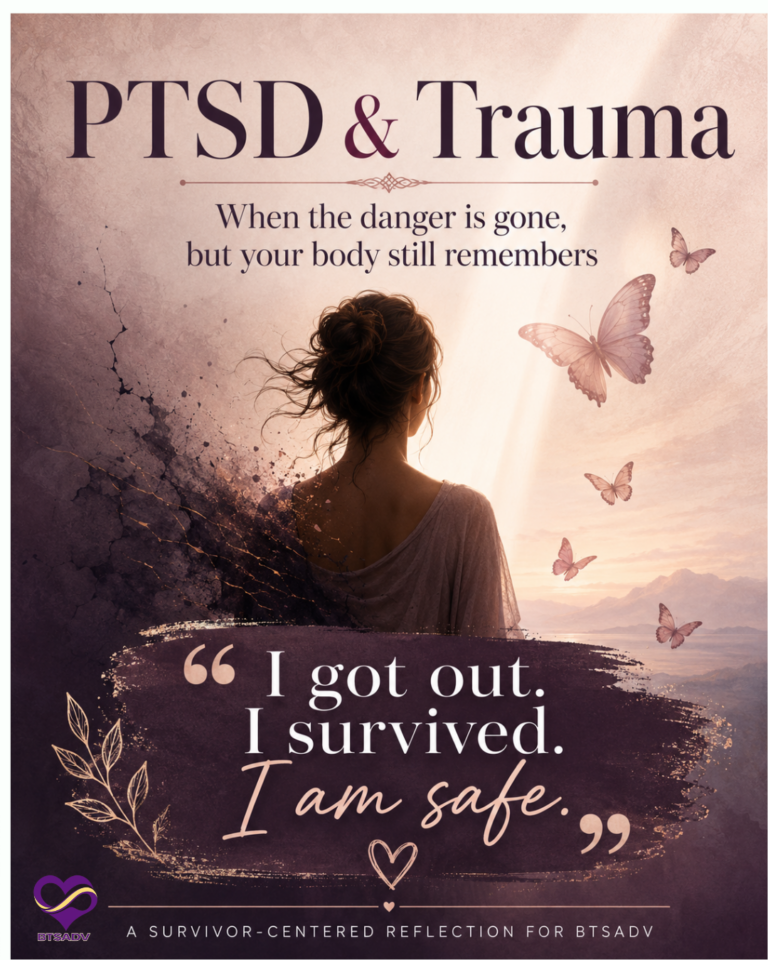
You survived, got out, are safe here!
Healing from domestic violence is not always forgetting.
Sometimes healing is remembering without being controlled by the memory.
Healing is noticing the trigger and being able to say, This reminds me of what happened, but it is not happening again.
It is explaining to the people who love you why certain things make you uncomfortable.
Healing is creating boundaries that other people may not fully understand.
Sometimes it is simply giving yourself grace when your body responds to an old danger in a new and safe place.
I guess there are some memories and experiences that will forever shape me, but being shaped by something is not the same as being imprisoned by it!
Six years ago, I drove toward the interstate with my children and whatever we could carry.
I was leaving behind a life of fear.
I didn’t know then that freedom would require more than physically getting away. I’d also have to learn how to feel safe again. I’m still learning.
Every time I recognize a trigger, every time I remind myself where I am, every time I choose peace over panic, and every time I allow myself to live without constantly preparing for the next attack, I reclaim another piece of the life I almost lost.
The trauma may be part of my story.
But it does not get to write the ending.
Support Line: 1-855-BTS-1777
Hours: 9 a.m.–9 p.m. CST, 7 days a week
Break The Silence Against Domestic Violence
National Domestic Violence Hotline
Call: 1-800-799-SAFE (7233)
Text: START to 88788
Online chat: The National Domestic Violence Hotline