By Amber Harris
One of the hardest things to process after an abusive relationship is realizing that some of the stories you believed may not have been true.
For years, I believed the story he told me about his military service.
He said he had been injured in an explosion while deployed to Afghanistan. According to him, the injury included serious back problems and separated discs. Surgery, he claimed, had been recommended, but he had continued putting it off.
Another part of his story involved leaving the military. He told me that when his service was ending, he had been given a choice: undergo the surgery or separate from the military.
I believed him.
Because of those claims, I often wondered why he had only a 40% VA disability rating. I encouraged him to apply for additional benefits because I genuinely believed he had suffered serious service-related injuries and deserved whatever benefits he was legally entitled to receive.
His response did not make me question the story.
Instead, he would say that he did not feel comfortable taking advantage of the benefits.
At the time, I interpreted that as humility.
Someone who had experienced what I believed he had endured, yet still felt uncomfortable accepting additional benefits, seemed humble to me. That explanation actually strengthened my belief in everything he had told me.
Looking back, I can see how easily one part of a story can reinforce another.
What I interpreted as humility became another reason I convinced myself that the story had to be true.
When Military Trauma Became Part of the Explanation
Then there was an incident of domestic violence.
When I spoke with the responding officer, I explained that I believed he might have PTSD from his military service in Afghanistan.
The officer was also a former member of the military. That made me feel even more comfortable explaining what I believed had happened to him.
I thought I was providing important context.
In my mind, this was a veteran who had suffered a serious injury, experienced combat-related trauma, and might be struggling with the effects of PTSD.
Because of that belief, I asked the officer to take him to a veterans’ volunteer organization instead of taking him directly to jail.
I was trying to help him.
Later, I even asked the judge to dismiss the domestic violence charge because I believed his behavior was connected to PTSD and unresolved military trauma.
She did.
Today, that is difficult for me to process.
Not because I regret caring about someone I believed was struggling.
The painful part is realizing that I made decisions about his consequences based on a story I had never independently verified.
The Questions I Could Not Ignore
During the breakdown of our relationship, we were driving behind a vehicle displaying a Purple Heart license plate.
That brought a question to the surface that had been sitting in the back of my mind.
If he had been injured in combat, why had he never received a Purple Heart?
His explanation was that his NCO had never put him in for one and that he had never pushed the issue himself.
Once again, I believed him.
Later, I got to know his former wife, who had been married to him while he was deployed. She told me that she had never known him to have been injured.
That conversation changed something for me.
Questions that had previously been pushed aside suddenly became impossible to ignore.
Eventually, I found his DD214 and began looking at the military documentation myself.
What I found did not match the story I had been told.
His separation was listed as the end of his contract, rather than a medical separation.
That caught my attention because I had been told his military career ended because he had supposedly been given the choice between surgery and separation.
Those are very different explanations.
The Purple Heart story raised another question.
I had been told that his NCO simply had not submitted him for one. My later understanding was that the Purple Heart process was more complicated than that explanation suggested and was not simply a matter of one NCO having unilateral authority to award the decoration.
I want to be careful about what I claim.
Was not present during his military service.
Do not have every military record.
One document does not necessarily tell an entire story.
Another person’s account should not automatically be treated as complete either.
What I can speak about is what happened to my understanding of the story.
The version I had been told did not match the documentation I later found.
That realization forced me to look back at the decisions I had made while believing his account.
I Thought I Was Protecting a Wounded Veteran
At the time, I thought I was dealing with a wounded veteran struggling with trauma.
I encouraged him to pursue additional VA disability benefits.
Told law enforcement that I believed he had PTSD.
Explained the military trauma I believed he had experienced.
Veterans’ resources seemed like a better option to me than immediate punishment.
I asked a judge to dismiss the domestic violence charge because I believed there was a trauma-related explanation behind his behavior.
My intentions were based on compassion.
My understanding, however, was based on information that I had accepted without independently verifying it.
That distinction became incredibly important.
I had not simply believed a story about military service.
I had used that story to explain his behavior.
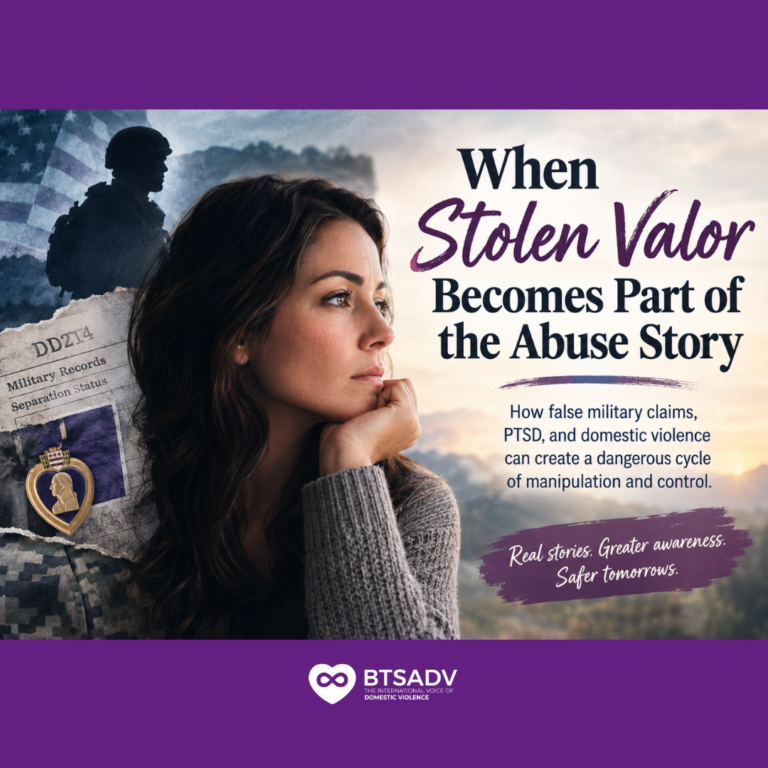
When Stolen Valor Becomes Part of an Abuse Narrative
The conversation surrounding stolen valor and narcissistic abuse can be complicated.
Stolen valor is often discussed in connection with false or exaggerated claims about military service, awards, injuries, or accomplishments. Within an abusive relationship, however, a questionable military narrative can become part of something much larger.
The person may present themselves as the wounded hero.
They may emphasize sacrifice.
They may describe experiences that supposedly make them deserving of special understanding.
Their alleged trauma can become the explanation for anger, instability, frightening behavior, or mistreatment.
For someone close to them, that narrative can influence how everything else is interpreted.
You may excuse anger because you believe:
“He’s traumatized.”
Fearful behavior may be rationalized with:
“He has PTSD.”
Others may be challenged because you believe you are protecting someone who served their country.
Even your own safety can become secondary because you are focused on helping the person you believe was wounded.
That is what happened to me.
PTSD Does Not Excuse Domestic Violence
Real veterans deserve respect.
Military service deserves recognition.
Combat injuries deserve compassion.
PTSD is real. Military trauma is real.
None of those truths mean that abuse should be excused.
A person can experience PTSD and still be responsible for abusive behavior.
Someone can also be abusive without having PTSD.
Understanding trauma does not require accepting violence.
Compassion does not require abandoning boundaries.
Military service does not give anyone permission to hurt another person.
Most importantly, PTSD does not cause someone to abuse a partner, nor does a PTSD diagnosis excuse domestic violence.
I had confused understanding someone with excusing someone.
My thinking was simple at the time.
If I could understand what had happened to him, perhaps I could understand why he treated me the way he did.
His trauma, if real, meant I needed to be more patient.
Compassion meant believing him.
Eventually, I learned that compassion and unquestioning belief are not the same thing.
You Can Have Compassion Without Ignoring the Facts
Respecting someone’s military service does not mean you have to accept every claim they make.
Acknowledging that trauma exists does not require accepting every explanation offered for harmful behavior.
Compassion for someone’s past does not require sacrificing your safety in the present.
Questions are allowed.
Boundaries are allowed.
Verification is allowed.
If someone’s version of events repeatedly conflicts with available documentation, it is reasonable to pause and examine what you actually know.
Not every inconsistency proves that someone is lying.
Not every discrepancy tells the entire story.
At the same time, your safety should never depend on blindly accepting another person’s narrative.
The Hardest Part Was Looking at What I Had Done
For me, the most painful realization was not simply discovering that pieces of his story might not have been true.
It was understanding how much I had done because I believed the story.
I had advocated for him.
Protected him from consequences.
Explained his behavior through the lens of trauma.
Encouraged him to seek additional benefits.
Asked for veterans’ resources.
I had asked a judge to dismiss a domestic violence charge.
All of those decisions were made because I believed I was helping someone who had been seriously injured and traumatized.
Meanwhile, my attention was focused on understanding what had supposedly happened to him.
I was not asking nearly enough about what was happening to me.
That is one of the hardest lessons I carried out of the relationship.
Sometimes an abusive person does not have to demand that you ignore your own suffering.
They simply have to give you a story that makes you believe their suffering matters more.
Your Safety Matters Too
Survivors can spend enormous amounts of energy trying to understand why an abusive partner behaves the way they do.
Maybe it is trauma.
Is PTSD.
Maybe it is childhood experiences.
Is military service.
Or something else entirely.
Those questions can matter, but they should never replace the most important question:
What is happening to me?
Someone else’s history does not erase your experience.
Their trauma does not cancel your boundaries.
Military service does not excuse abuse.
Explanation for their behavior does not require you to remain in danger.
Looking back, I wish I had understood that sooner.
I could have cared about his experiences without carrying responsibility for them.
Have respected military service without accepting every story I was told.
Believed in the reality of PTSD without using it to explain away domestic violence.
Most importantly, I could have shown compassion without abandoning myself.
Sometimes healing begins when we stop asking only, “What happened to them?”
We also have to ask:
“What happened to me?”
And perhaps even more importantly:
“What do I need now to be safe?”