By Iris Pendelton
Why Strangulation in Domestic Violence Is a Serious, Life-Threatening Warning Sign
Trigger Warning: This post discusses non-graphic references to strangulation and domestic violence. The content may be emotionally difficult, especially for survivors of abuse or trauma. Please take care of yourself while reading. If you need support, confidential help is available in the U.S. through the National Domestic Violence Hotline at 1-800-799-SAFE (7233) or by texting START to 88788.
Words Matter More Than We Realize
There is a phrase many survivors use casually — almost without thinking:
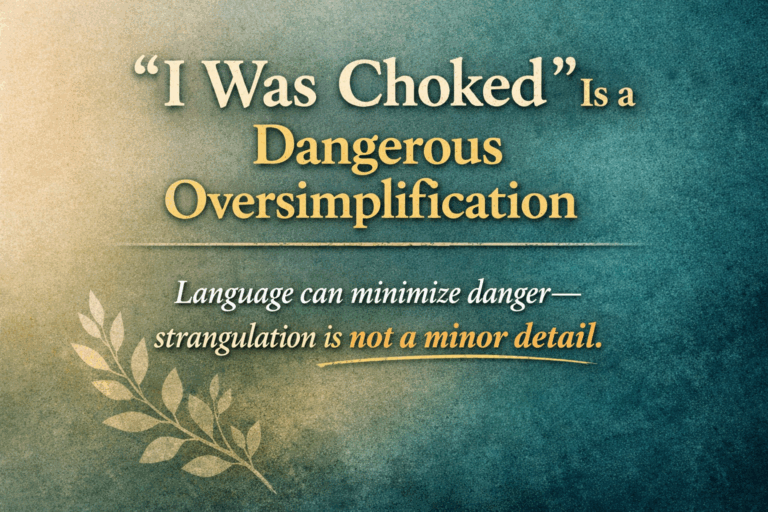
“I was choked.”
For a long time, I used that phrase too.
Most of us do. It’s the word we’ve heard our whole lives. But medically and legally, choking and strangulation are not the same thing — and confusing them can be dangerous.
Choking vs. Strangulation: The Difference That Can Save a Life
- Choking happens when something blocks the airway from the inside (like food).
- Strangulation happens when pressure is applied to the outside of the neck, cutting off blood flow or oxygen to the brain.
That distinction matters — a lot.
Strangulation can cause:
- Loss of consciousness in seconds
- Brain injury without visible signs
- Stroke hours or days later
- Delayed death, even after the incident seems “over”
And here’s the most important truth:
Strangulation is one of the strongest predictors of homicide in domestic violence cases.
This isn’t just another argument that went too far. It’s a medical emergency and a serious warning sign of escalating violence.
Why Strangulation Is So Dangerous — Even Without Marks
One of the reasons strangulation is so often minimized is because it doesn’t always leave bruises.
There may be:
- No fingerprints
- No visible swelling
- No obvious injuries
But internally, the damage can be severe.
A person can lose consciousness in less than 10 seconds. Brain injury can occur even if they “come to” quickly. Death can happen hours or days later, long after the incident has ended.
This is why many survivors don’t realize how close they came to losing their lives.
We Saw This Play Out in Real Time
The story of Gabby Petito shook the world — not because domestic violence was rare, but because we saw how easily warning signs can be missed or minimized.
Like so many survivors, her situation was described as:
- Stress
- Relationship problems
- A bad argument
What we now know is that strangulation was part of her story.
And tragically, that single detail told us everything we needed to know about how dangerous her situation truly was.
Her story is not unique.
It is devastatingly common.
The Day Everything Became Clear
For me, strangulation was the moment everything changed.
It wasn’t dramatic.
It wasn’t loud.
It wasn’t even emotional at first.
It was clarity.
My body understood before my mind could catch up:
If I stayed, I would not survive.
I realized this wasn’t about love.
Or fixing things.
Or trying harder.
It was about whether my children would grow up with their mother.
That was the day I decided to leave — not because I felt brave, but because my body had already received the warning.
And statistically, it was right.
Why We Have to Talk About Strangulation
Strangulation is:
- Common
- Underreported
- Frequently minimized
- Extremely dangerous
Many survivors don’t seek medical help.
Many don’t tell the full story.
Many don’t realize how close they came to dying.
But awareness saves lives.
If you are reading this and recognizing yourself, please hear this clearly:
- What happened to you matters.
- Your fear is valid.
- You are not overreacting.
- You deserve safety.
Leaving is not simple.
It is not always immediate.
And it is never easy.
But understanding the danger is often the first step toward survival.
A Quiet but Urgent Reminder
If someone has ever:
- Put their hands around your neck
- Restricted your breathing
- Affected your vision
- Caused you to lose consciousness — even briefly
That was not “just choking.”
That was strangulation.
And it is a medical and safety emergency.
You are not dramatic.
You are not imagining things.
You are responding to real danger.
You Are Not Alone
If you or someone you love needs help, confidential support is available in the U.S. through the:
National Domestic Violence Hotline
📞 1-800-799-SAFE (7233)
📱 Text START to 88788
🌐 thehotline.org
Sharing this story isn’t easy — but silence helps no one.
If this helps even one person recognize the warning signs sooner than I did, then it’s worth it.
Because we deserve more than survival.
We deserve safety.
We deserve freedom.
We deserve to live.