By Shannon Brown
Growing Up with Abuse Behind the Holiday Mask
The holiday season is usually sold to us as a montage of warm light, oversized sweaters, laughter around crowded tables, and effortless joy. But for a child living in a home shadowed by abuse, the holidays carry a very different rhythm, one dictated by performance, heightened anxiety, and the quiet dread of what comes next.
Childhood trauma doesn’t look identical in every house. Abuse wears many masks, and during the holidays, those masks often become more elaborate, more rigid, and far more dangerous.
The “Best Behavior” Charade: When the Monster Wears a Smile
For many kids, the most confusing part of growing up with an abuser is the jarring contrast between public spectacle and private terror.
In these homes, the abuser is often the life of the party. When extended family, neighbors, or friends arrive, an invisible switch flips. The voice softens, the smiles are generous, they laugh at jokes, carve the turkey, hand out gifts with theatrical warmth, and present the image of a devoted, loving protector.
To an outside guest, the house looks picture-perfect. But to the child watching from across the living room, that charm isn’t comforting; it’s sickening.
You learn early on to read the micro-expressions, the tightening of a jaw while telling a funny story, the cold look that passes over their eyes right before they laugh, the grip on your shoulder that looks affectionate to the room but digs just hard enough to remind you who is in charge.
As a child, you don’t get to enjoy the warmth of company. Instead, you spend the entire afternoon or evening counting down the hours, bracing for the inevitable. You know the golden rule of the house: the performance requires an immense amount of energy, and the debt always comes due.
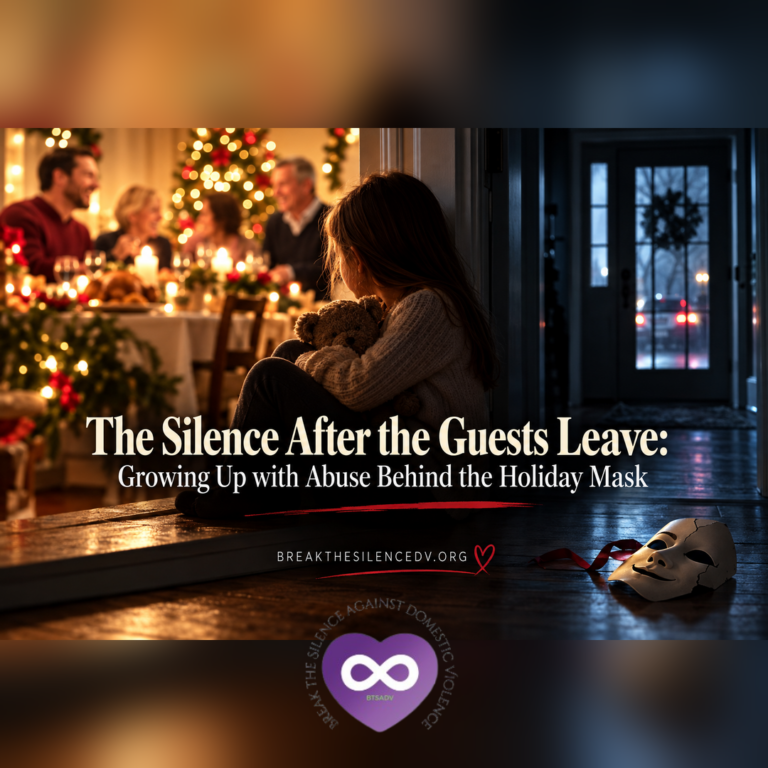
The minute the front door clicks shut and the tail lights pull out of the driveway, the mask drops. The silence that follows is suffocating.
Sometimes the explosion is immediate, triggered by a perceived slight, a dish placed in the wrong spot, or simply the exhaustion of having pretended to be a decent human being for four hours. Other times, it is a slow, cold burn: days of walking on eggshells, listening to door hinges creak, and waiting for the shoe to drop. The contrast makes you feel gaslit by your own reality. If everyone else thinks they are wonderful, who would ever believe what happens in the dark?
The Other Faces of the Holiday Season
While public charm followed by private retaliation is a painfully common pattern, holiday dynamics can shift depending on the environment, the nature of the abuse, and custody arrangements:
1. The Pre-Planned Sabotage
In some homes, the abuser cannot stand attention being on anyone else. Rather than putting on a show, they systematically ruin key moments before they happen. They pick catastrophic arguments on Christmas Eve, destroy presents in secret, start screaming matches right before leaving for an event, or disappear entirely, leaving behind a wake of tears and panic. The holiday becomes about managing their volatile mood rather than any sense of celebration.
2. The Trap of Financial and Material Control
Abuse often hides behind lavish generosity. An abuser may shower children with extravagant gifts in front of an audience, only to weaponize those very items the next day. Gifts become leverage: “Look at everything I bought you, and this is how you treat me?” Toys can be confiscated, broken as punishment, or used to enforce silence. For the child, opening presents isn’t magical; it’s accepting a debt they know they’ll be forced to pay back with obedience and fear.
3. High-Conflict Custody and the Dread of Exchange Days
For children of separated or divorced parents where one home is unsafe, the holidays are carved up into custody schedules and neutral-site handoffs. The days leading up to the transfer are plagued by physical symptoms, stomachaches, sleeplessness, and withdrawal. The child spends the holiday in survival mode, carefully modulating their behavior to avoid setting off the abuser, all while counting down the minutes until they can return to safety.
4. The Complete Isolation
Some abusers respond to the holidays by tightening the perimeter. They intentionally cut off extended family, forbid traditions, refuse to let children attend school parties, or manufacture feuds to ensure no outside eyes see into the home. For these children, the holidays are defined by an eerie quiet and profound loneliness, watching the world celebrate from behind closed blinds.
The Lasting Echo for Adult Survivors
When you grow up this way, your nervous system remembers long after you’ve left the house.
As adults, survivors often struggle with the holiday season in ways that others find hard to understand. The sound of forced laughter can trigger panic. Cleaning up after dinner can feel like clearing a blast radius. A simple, quiet evening after guests leave can evoke the phantom dread of impending violence.
Healing begins with dismantling the myth that holidays have to look like a Norman Rockwell painting. It means acknowledging the truth of what happened behind closed doors:
* Your perception wasn’t wrong. The charm everyone else saw was a tool, not the reality. The reality was what happened when the door shut.
* You are allowed to opt out. You don’t owe anyone your presence at a holiday table that compromises your peace or forces you to play a role in a performance.
* You get to build your own quiet. Safe holidays don’t have to be loud, extravagant, or performative. Sometimes the greatest gift is an evening where the silence after the door closes is simply peaceful, safe, and entirely yours.
Break The Silence Against Domestic Violence provides survivor-focused support and resources.
Support Line: 1-855-BTS-1777
Hours: 9 a.m.–9 p.m. CST, 7 days a week
Break The Silence Against Domestic Violence. btsadv.org
National Domestic Violence Hotline
Call: 1-800-799-SAFE (7233)
Text: START to 88788
Online chat: The National Domestic Violence Hotline nationaldomesticviolencehotline.org